retinadijital@gmail.com – RTN House https://rtnhouse.com Digital Marketing Agency in Antalya Fri, 12 Jun 2026 10:37:15 +0000 en-US hourly 1 https://wordpress.org/?v=7.0 https://rtnhouse.com/wp-content/uploads/2025/10/cropped-rtn-favicon-32x32.png retinadijital@gmail.com – RTN House https://rtnhouse.com 32 32 Instagram Organic Reach in 2026: Is It Really Dead? https://rtnhouse.com/instagram-organic-reach-in-2026-is-it-really-dead/ Fri, 12 Jun 2026 08:53:03 +0000 https://rtnhouse.com/?p=11651 kullan. ================================================================ --> Instagram Organic Reach in 2026: Is It Really Dead? — RTN House
Social Media

Instagram Organic Reach in 2026: Is It Really Dead?

Your posts reach fewer followers than ever — and it’s not your imagination. But “dead” is the wrong word. Organic reach hasn’t disappeared; it has moved.
Buse ÇakıroğluJune 25, 2026 8 min read
RTN HOUSE · SOCIAL MEDIAInstagram Organic Reach 2026
QUICK ANSWER

Instagram organic reach is not dead in 2026 — but follower-based reach is fading. The average post now reaches only about 3.5–7.6% of followers, down from 10–15% in 2020. The opportunity has shifted from your follower list to algorithm-driven discovery through Reels, shares, and saves.

If your Instagram posts feel like they’re disappearing into a void, you’re not imagining it. Across 2025 and into 2026, organic reach has fallen sharply — and for business accounts especially, the old “post and your followers will see it” model barely exists anymore.

But the headlines calling organic reach “dead” miss the real story. Reach hasn’t vanished; the rules that govern it have changed completely. This guide covers the actual numbers, why it’s happening, and what still works in 2026.

What is organic reach — and what’s actually declining?

Organic reach is the number of unique people who see your content without you paying to promote it: your followers, plus anyone the algorithm shows it to in a non-follower’s feed. The important distinction — one platforms tend to blur — is between reach (unique people) and impressions (total views). When marketers say reach is declining, they mean fewer unique people are seeing each post, even if impressions hold steady.

That nuance matters in 2026, because some formats are losing reach while still racking up impressions from the same loyal viewers.

How steep is the decline in 2026?

The numbers are blunt. According to data compiled from Socialinsider and others, the average Instagram post now reaches a small single-digit share of a brand’s followers.

3.5–7.6%Avg. share of followers who see a post in 2026 (was 10–15% in 2020)
−12%Year-over-year organic reach drop, 2024→2025 (Socialinsider)
2.25×More reach from Reels vs. single-image posts
55%Of Reel views come from non-followers

Reach also depends heavily on account size: smaller accounts (under ~10K followers) still see roughly 8–15% reach, while large accounts (100K+) often see just 3–7%. In other words, a big follower count no longer guarantees big reach — and in many cases works against it.

Why is Instagram organic reach falling?

Three forces are compounding at once:

  • Content saturation. Far more content is published than any feed can show. Metricool’s analysis found reach falling across both Reels and posts simply because there’s too much competing for limited feed space.
  • Monetisation pressure. Platforms make money from ads, so unpaid business reach is structurally limited — the “pay-to-play” reality of mature social networks.
  • The shift to AI discovery. This is the big one. As industry data for 2026 shows, Instagram has moved from social-graph distribution (showing posts to your followers) to AI-driven recommendation (showing the best content to anyone likely to engage). Who follows you now matters less than what you post and how people react to it.
“Reach is no longer about who follows you — it’s about who shares you.”

So is organic reach actually dead?

No — but the old version of it is. Follower-based reach, where posting reliably reached your audience, is genuinely fading. What’s replacing it is arguably a bigger opportunity: non-follower discovery. With around 55% of Reel views coming from people who don’t follow you, a single strong piece of content can now reach audiences your follower count could never deliver.

Instagram’s own leadership has reinforced where the algorithm looks. Rather than rewarding follower relationships, it weights signals like watch time, likes, and especially shares and saves. The platforms aren’t punishing brands — they’re re-routing reach toward content people genuinely want to pass along.

What still works in 2026?

The accounts still growing aren’t the ones with the biggest followings — they’re the ones who understand how the algorithm now evaluates content. The fundamentals:

1. Make content built to be shared and saved

Shares and saves are weighted far more heavily than likes — DM shares in particular are treated as a strong quality signal. Ask of every post: would someone send this to a friend, or save it for later? If not, rework it.

2. Lead with Reels for discovery

Reels reach roughly 2.25× more people than static posts and are the primary engine of non-follower discovery. They don’t replace everything, but they should anchor a reach strategy.

3. Use carousels for depth and dwell time

Carousels keep people on a post longer, and that watch/dwell time is a ranking signal. They’re ideal for educational, save-worthy content.

4. Post consistently — but don’t spam

2026 data points to roughly 5–7 posts per week as the sweet spot, with diminishing returns above 10 and a real drop-off below 3.

5. Treat hashtags as a supplement, not a strategy

Hashtags are now secondary signals. A few (3–5) relevant ones help, but watch time, shares, and engagement quality decide reach — not hashtag volume.

THE RTN HOUSE TAKE

Stop posting for your followers. Post for the share.

The brands winning on Instagram in 2026 design content for the person who hasn’t followed them yet — and for the moment someone taps “send.” Reach follows shareability, not follower count.

How should brands measure success now?

If you’re still judging Instagram by follower growth and likes, you’re tracking the wrong era. The metrics that reflect how reach actually works in 2026:

  • Shares & saves — the strongest quality signals, and the best predictor of reach.
  • Non-follower reach % — how much of your reach comes from discovery (the growth engine).
  • Watch / dwell time — how long people stay with Reels and carousels.
  • Profile visits & follows from content — whether discovery turns into relationship.

Likes and follower count still have a place, but they’re vanity metrics next to these. Build a reporting view around shares, saves, and non-follower reach, and you’ll make far better content decisions.

Frequently asked questions

Is Instagram organic reach dead in 2026?+
No, but follower-based reach is fading. The average post reaches only about 3.5–7.6% of followers. Reach has shifted toward non-follower discovery through Reels, shares, and saves — so strong, shareable content can still reach large audiences.
Why did my Instagram reach suddenly drop?+
Three reasons usually combine: content saturation (too much competing content), platform monetisation limiting unpaid reach, and the algorithm’s shift from showing posts to followers toward AI-driven recommendation. Business accounts have been hit harder than personal or creator accounts.
Do Reels really get more reach than photos?+
Yes. Reels reach roughly 2.25× more people than single-image posts, and about 55% of their views come from non-followers — which is why they’re the main engine of discovery on Instagram in 2026.
How often should a brand post on Instagram in 2026?+
Around 5–7 posts per week is the sweet spot. Posting more than 10 times weekly shows diminishing returns, while fewer than 3 posts a week tends to hurt engagement and reach.
Do hashtags still help reach?+
Only as a supplement. Hashtags are now secondary signals; 3–5 relevant ones can help categorise content, but watch time, shares, and engagement quality drive reach far more than hashtag volume.

Want your content to actually get seen?

We build organic social strategies designed for the 2026 algorithm — share-worthy Reels, carousels, and content systems that earn discovery, not just likes.

Explore Social Media Management →
Buse Çakıroğlu
WRITTEN BY
Buse Çakıroğlu
Social Media & Content Specialist · RTN House

Leads organic social and content strategy at RTN House — building share-worthy Reels, carousels, and content systems that turn attention into discovery and measurable growth.

]]>
Medical Tourism Marketing: The 2026 Playbook for Clinics https://rtnhouse.com/medical-tourism-marketing-the-2026-playbook-for-clinics/ Fri, 12 Jun 2026 07:28:06 +0000 https://rtnhouse.com/?p=11631 Yoast/RankMath): • Title: Medical Tourism Marketing: The 2026 Playbook for Clinics • Slug: medical-tourism-marketing • Meta desc: How clinics attract international patients in 2026 — the channels, strategy and trust system behind medical tourism marketing that converts. • Primary: medical tourism marketing • Secondary: health tourism marketing · how to attract international patients • Schema: Article + FAQPage (en altta JSON-LD olarak hazır) GÖRSEL: • Yazar fotoğrafı + (opsiyonel) öne çıkan görsel için src değerlerini Medya Kütüphanesi'nden aldığın TAM URL ile değiştir. ================================================================ --> Medical Tourism Marketing: The 2026 Playbook for Clinics — RTN House
Health Tourism

Medical Tourism Marketing: How Clinics Attract International Patients in 2026

Demand is larger than ever and so is the competition. The clinics that win international patients aren’t the ones spending the most — they’re the ones that build trust at a distance with a real system.

Şimal YolgösterenJune 16, 2026 8 min read
Medical tourism marketing — the 2026 playbook for clinics
QUICK ANSWER

Medical tourism marketing is the system clinics use to win patients from other countries — combining multilingual SEO, paid ads, a conversion-focused website and trust assets like reviews and accreditation. Because international patients decide entirely online before they ever fly, the winners reduce uncertainty at every step.

Healthcare costs are rising and waiting lists are growing across much of the developed world, so patients are increasingly willing to travel for faster, more affordable, high-quality treatment. That shift has turned medical tourism into one of the fastest-growing service-export sectors anywhere — and the clinics that market well are the ones capturing it.

This guide explains how medical tourism marketing actually works in 2026: the size of the opportunity, why international patients behave differently, the channels that move the needle, and a step-by-step strategy you can apply to your own clinic.

What is medical tourism marketing?

Medical tourism marketing is the practice of attracting and converting patients from abroad into booked treatments at your clinic. Unlike local marketing — where a patient can simply walk in, meet the doctor and decide — international patients rely almost entirely on what they find online. Your website, your reviews, your ad and your follow-up are the clinic in their eyes until the moment they land.

That single difference reshapes everything: medical tourism marketing is less about promotion and more about building trust at a distance.

How big is the medical tourism opportunity in 2026?

The numbers explain the competition. According to Grand View Research, the global medical tourism market was worth roughly USD 34 billion in 2025 and is projected to grow at double-digit rates through the next decade. Turkey sits at the centre of that growth.

~$34BGlobal medical tourism market, 2025 (Grand View Research)
13.5%Turkey’s share — the world’s #1 destination in 2025
~1.4MInternational patients served by Turkey in 2025 (USHAŞ)
42JCI-accredited hospitals across Turkey

Official figures from USHAŞ, Turkey’s state agency for international health services, show the country served close to 1.4 million international patients in 2025, generating around USD 3 billion in revenue. A few structural advantages keep Turkey ahead, according to analyses from Mordor Intelligence and Global Market Insights: cost savings of roughly 50–70% versus Western Europe, more than 40 JCI-accredited hospitals, and an Istanbul flight radius of about four hours to London, Frankfurt, Dubai and Riyadh.

Demand is concentrated in a handful of markets — and each one needs its own language and message:

Germany / DACH
LANGUAGE: German

High spending power and long waiting times. Trust, certification and GDPR compliance are decisive.

United Kingdom
LANGUAGE: English

Price–quality balance leads; the “trusted alternative” perception matters most.

Netherlands
LANGUAGE: Dutch / English

Strong demand in dental and aesthetics; a native-language page lifts conversion.

Gulf & neighbouring
LANGUAGE: Arabic / English

Premium positioning, a luxury experience and fast response are expected.

The takeaway for a clinic owner: demand is large and growing, but visibility alone is no longer enough — you need a marketing system built specifically for the international patient.

Why do international patients decide differently?

A local patient evaluates your clinic in person. An international patient evaluates it through a screen, often from thousands of kilometres away, weighing three concerns above all:

  • Quality — Is the doctor genuinely qualified? Is the clinic accredited?
  • Safety — What happens if something goes wrong? Is there a clear post-treatment plan?
  • Cost and clarity — What exactly is included, and are there hidden surprises?

Because they cannot verify any of this in person, they look for proof: accreditation logos, real patient reviews, before-and-after results, doctor credentials and clear, transparent information in their own language. Every missing or confusing element raises doubt — and doubt is what stops a booking.

“Effective medical tourism marketing is, at its core, the work of systematically removing doubt.”

Which channels actually bring international patients?

No single channel builds a sustainable patient flow. The clinics that grow combine several, in a deliberate order.

1. International SEO & multilingual content

Most patient journeys begin with a search. Ranking for procedure-specific terms in each target language — and answering real questions about cost, recovery, logistics and safety — builds organic, ad-independent demand. A genuinely localised site beats machine translation every time.

2. Paid advertising: Meta + Google together

Meta creates awareness and starts the research process for someone who isn’t searching yet; Google Ads captures intent when a patient is actively looking. Used together with language-matched creative, they shorten the path from first impression to inquiry.

3. A conversion-focused, multilingual website

Traffic without conversion is wasted budget. International patients need fast load times, clear treatment information, visible trust signals and frictionless contact — strong CTAs, simple forms and WhatsApp integration. This is exactly where a purpose-built clinic website and landing page turns ad clicks into qualified inquiries.

4. Trust assets

Accreditation badges (such as JCI), video testimonials from former international patients, transparent doctor profiles and verified reviews are the psychological bridge that lets a stranger commit to surgery abroad.

5. CRM and fast follow-up

Many clinics generate inquiries and then lose them to slow follow-up. A proper CRM ensures every lead is tracked, nurtured in their language and answered quickly — often the difference between an inquiry and a booked patient.

THE RTN HOUSE APPROACH

One system, not one channel

When SEO, paid media, a multilingual website and CRM work as a single system, the result is a patient pipeline that keeps producing even when ad spend pauses — instead of a flow that stops the moment you turn the ads off.

How do you build a medical tourism marketing strategy, step by step?

A repeatable framework beats scattered tactics. This is the structure we apply for clinics at RTN House:

  • Discovery & research — your services, strongest procedures, competitors and winnable markets.
  • Target-market selection — specific countries (UK, Germany, Netherlands) by demand, cost gap and cultural fit, not “everyone, everywhere.”
  • Positioning & messaging — what makes your clinic credible and different, expressed consistently.
  • Channel prioritisation — technical foundation and multilingual site first, then SEO, then paid acquisition.
  • Creative & conversion — language-matched ads, landing pages and trust content built around patient intent.
  • Tracking & optimisation — measure cost per lead, conversion rate and revenue per patient, then reallocate budget toward what works.

What mistakes cause clinics to lose international patients?

  • Relying on a single channel. One ad account or one language is fragile — when the budget stops, the patients stop.
  • Language mismatch. English ads to a German-speaking audience, or machine translation, quietly destroy conversion.
  • A slow or untranslated website. Long load times and unclear information lose patients before they ever inquire.
  • No follow-up system. An inquiry that waits 48 hours is usually lost to a faster competitor.

How do you measure success in medical tourism marketing?

Avoid judging performance by a single number. A healthy view combines the short term (cost per lead, lead-to-consultation conversion, average revenue per patient), the medium term (organic traffic growth, review score, referral rate), and the long term (brand awareness, market share, and a sustainable flow of organic patients). When every channel works as one system, the result is a pipeline that keeps producing while you sleep.

Frequently asked questions

What is the best marketing strategy for medical tourism?+
There’s no single best tactic. The strongest approach is a multi-channel system: international SEO for organic demand, Meta and Google ads for reach and intent, a fast multilingual website for conversion, and CRM-driven follow-up — all tied together by trust assets like accreditation and patient reviews.
How do clinics attract international patients online?+
By building a high-trust digital presence: a mobile-friendly site with dedicated pages in each target language, visible accreditations, real testimonials, and procedure-specific SEO that ranks in target countries — supported by paid ads and fast, personal follow-up.
Why is Turkey a leading medical tourism destination?+
Turkey combines 50–70% cost savings versus Western Europe, more than 40 internationally accredited hospitals, a four-hour flight radius to major European and Gulf cities, and deep expertise in cosmetic, dental and hair-transplant procedures — which is why it led the global market in 2025.
How long does medical tourism marketing take to show results?+
Paid channels can generate the first qualified inquiries within weeks, while SEO and content typically build momentum over three to six months. The two work best together — ads for immediate flow, organic for long-term, lower-cost growth.

Build your international patient pipeline

From target-country selection to multilingual websites, performance ads and CRM — let’s engineer the end-to-end system together for the UK, DACH and Dutch markets.

Let’s Talk on WhatsApp →
Şimal Yolgösteren
WRITTEN BY
Şimal Yolgösteren
Digital Marketing Specialist · RTN House

Leads performance marketing for health tourism and e-commerce brands at RTN House — specialising in Meta & Google Ads, conversion-focused web design and multilingual content for the UK, DACH and Dutch markets.

]]>
Target Countries in Health Tourism: How to Win More International Patients with Advertising Incentives https://rtnhouse.com/target-countries-in-health-tourism-how-to-win-more-international-patients/ Mon, 08 Jun 2026 10:37:49 +0000 https://rtnhouse.com/?p=11588 Target Countries in Health Tourism: How to Win More International Patients with Advertising Incentives — RTN House
Health Tourism

Target Countries in Health Tourism: How to Win More International Patients with Advertising Incentives

Clinics that target the right country, in the right language, with the right message turn a state-supported promotion budget into real patient appointments. Here is the blueprint for a sustainable flow of international patients.

RH RTN House June 8, 2026 9 min read
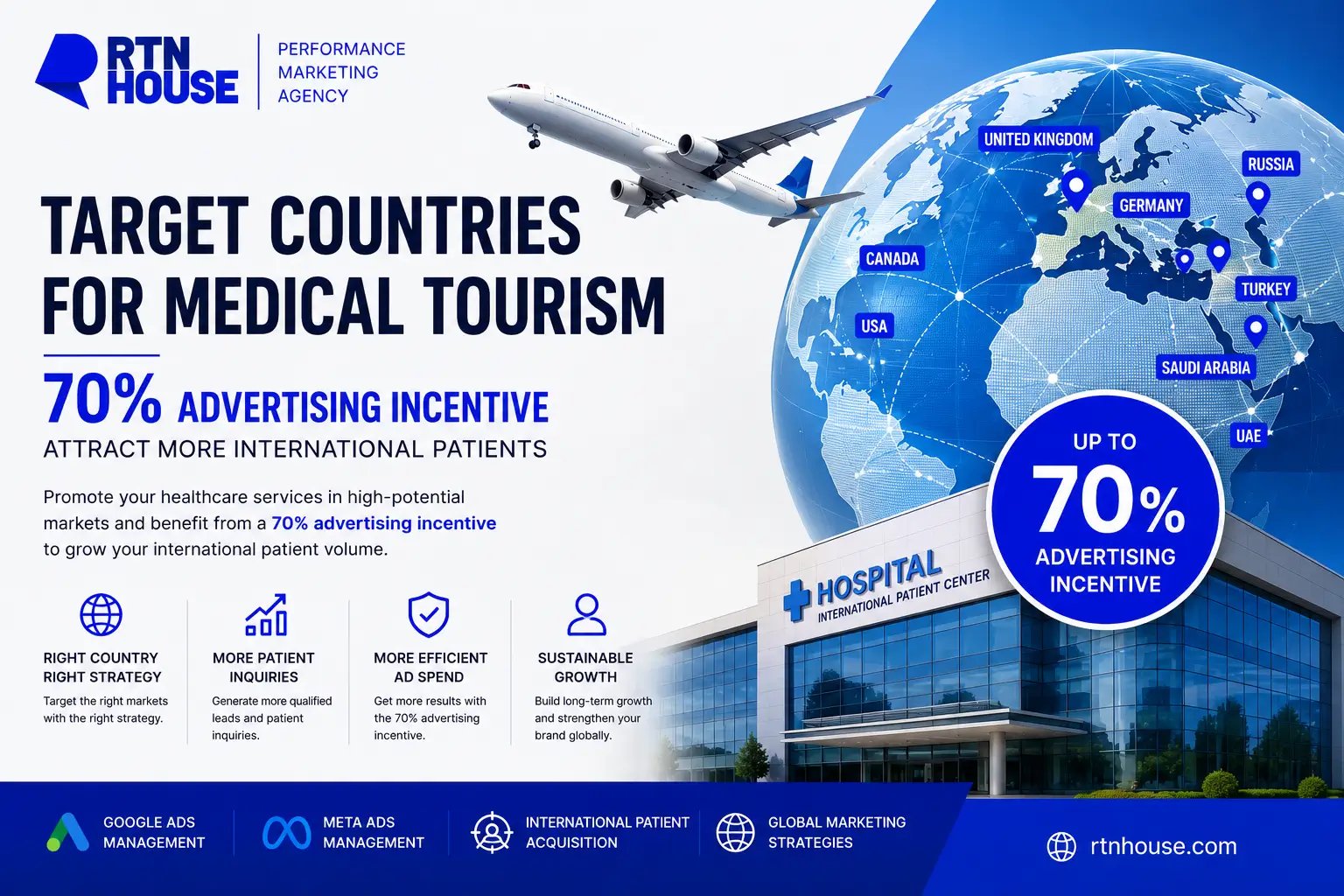
How the incentive rate in medical tourism rises to 70%

Turkey is one of the world’s strongest health tourism destinations for hair transplants, dental treatments, aesthetics and eye surgery. But the number of clinics competing for this market grows every year. Winning is not about spending more on ads — it is about choosing the right country and reaching it with the right language, a state-supported budget, and a measurable system.

In this article we cover why country selection is the heart of the strategy, how promotion and advertising incentives actually work, and the system architecture that converts that budget into real appointments.

Why country selection comes first

A universal English ad will not perform the same in every market. A patient in Germany makes decisions differently from one in the UK or the Gulf: expectations, trust signals, price perception and even the preferred contact channel all change. Campaigns built without a clear target country spread the budget across a broad, inefficient audience.

Country choice also drives your language, creative and offer decisions. The DACH region (Germany, Austria, Switzerland) is especially attractive thanks to high spending power and long waiting times, while in the UK the price–quality balance and the “trusted alternative” perception take centre stage.

“More patients don’t come from spending more on ads — they come from reaching the right country with the right system.”

How advertising & promotion incentives work

Health tourism is one of the sectors supported by the Turkish state. Within this framework, a portion of a clinic’s promotion, advertising, digital marketing and trade-fair expenses can be reimbursed as a grant when eligibility conditions are met. This support logic has two key consequences:

  • Your effective ad budget grows: for the same net cost you can run more tests and try more creatives.
  • Spending toward target countries is advantageous: support is generally applied on more favourable terms for promotion aimed at designated target countries, turning country selection into a direct financial decision.
The RTN House Approach

Use the incentive as a multiplier, not a discount

Think of the supported budget not as “free advertising” but as leverage that scales validated campaigns. First find the message that works on a small budget, then grow it confidently with the incentive.

Disclaimer: Incentive rates, eligibility conditions and the target-country list can change by programme and period. Before applying, please verify the current terms with the Turkish Ministry of Trade or an authorised consultant. This content is for general information only.

Priority target countries & language strategy

There is no single “best country” for every clinic; the best country depends on your treatment area, price positioning and operational capacity. Below are markets that commonly stand out, with communication notes:

Germany / DACH
LANGUAGE: German

High spending power, long waiting times. Trust, certification and GDPR compliance are decisive.

United Kingdom
LANGUAGE: English

Price–quality balance leads. Compliance with ASA/CAP advertising rules is essential.

Netherlands
LANGUAGE: Dutch / English

Strong demand in dental and aesthetics; a native-language landing page lifts conversion.

Gulf (UAE, Saudi, Qatar)
LANGUAGE: Arabic / English

Premium positioning, a luxury experience and fast response are expected.

Practical rule: start with one country and one landing page language, then carry the proven model to a second market. Spreading across five countries at once slows down learning.

The system that turns budget into appointments

An incentivised budget alone does not bring patients; converting that interest into appointments requires an end-to-end system. Four components must work together:

1. Performance ads (Meta + Google)

Google captures intent (search); Meta creates demand. The two channels should be managed with separate campaign structures per country and language.

2. Native-language landing page

Pages in the same language as the ad, that load fast and focus on a single action (form / WhatsApp), markedly increase conversion.

3. CRM and fast response

Incoming leads should be collected in a central CRM, with first-response time measured in minutes. In health tourism, speed is one of the strongest drivers of closing.

4. Content and trust

Case results, doctor profiles and genuine patient experiences build the “trusted alternative” perception, especially in the DACH and UK markets.

Advertising regulation & compliance

Health advertising is sensitive in every market. To keep your account safe and protect your brand, the core compliance topics are:

  • United Kingdom: ASA/CAP rules; avoid exaggerated or guarantee-based claims.
  • DACH: data collection and consent management under GDPR/DSGVO.
  • Meta health policies: compliance with platform rules on before/after imagery and targeting.

Frequently asked questions

Which country should I start with?+
Start with a single market that best fits your treatment area and price positioning. For dental and aesthetics, the UK and DACH are strong starting points; scale once you have proven the model.
Can I run unlimited ads thanks to the incentive?+
No. Support depends on specific conditions, upper limits and target-country scope. Verify the current terms from an authorised source before applying.
Must the landing page be in the country’s language?+
It is not mandatory, but it significantly affects conversion. Matching the ad language with the page language raises trust and form-completion rates.
How should I measure results?+
Measure by qualified leads that convert to appointments and cost per patient — not by clicks. Connecting CRM data to ad data is essential.

Let’s engineer your international patient flow

From target-country selection to an incentivised ad structure, from landing page to CRM — let’s plan the end-to-end system together.

Let’s Talk on WhatsApp →
RH
RTN House
Antalya-based digital marketing & health tourism agency
]]>